Every cursive letter, written out stroke by stroke
Cursive is easier to learn when you can see the pen move. This site shows every capital letter, lowercase letter and number written stroke by stroke, with numbered steps that say where the pen starts, which way it goes and where it stops.
Now writing capital A
The cursive alphabet
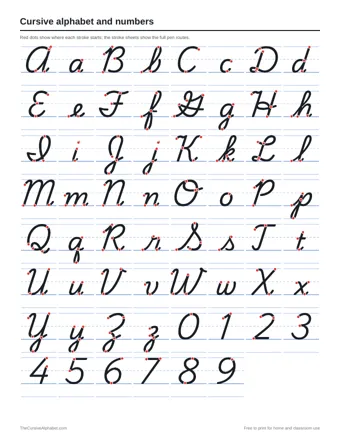
Each letter page shows the capital and lowercase letter together, plus any common second form.
Numbers
How to use the site
Watch the letter
Press play on any letter page. The pen draws the letter at writing speed, and each numbered step lights up as the pen reaches it. Tap a step to see just that stroke, or slow it down.
Read the steps
Each step is written in plain words: where to start, which way to curve, where to stop. The steps follow the way cursive is taught in US schools.
Print and practice
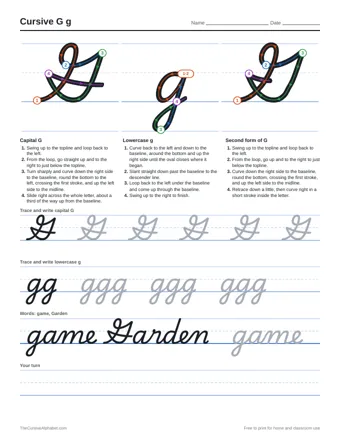
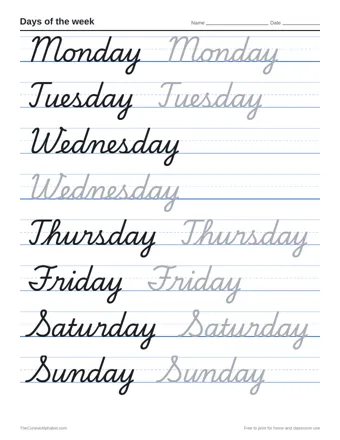
Every letter has a free practice sheet with the stroke guide, rows to trace and room to write. There are alphabet charts, word and sentence sheets, ruled paper, and a worksheet maker for your own words.
Print and practice
Free PDFs for home and the classroom.
Guides
Grip, joins, teaching kids, relearning as an adult, and fixing common mistakes.
Pen grip, posture and paper angle for cursive
Most trouble with cursive is not about the letters. It is about a cramped grip, a hunched back, or paper that sits at the wrong angle. Fix those three and the letters get easier at once.
How cursive letters join
A cursive word is one movement, not a row of separate letters. The way each letter ends decides how it connects to the next, and there are only a few patterns to learn.
Teaching cursive to kids: a four-week starter plan
You do not need a full curriculum to teach cursive. Ten minutes a day, the right order of letters, and a bit of patience will take a child a long way in a month.
Where to start
The site is written for adults: parents helping a child, teachers who need a chart or a sheet, and anyone relearning cursive after years of typing. The letters are a traditional American school cursive, the style most US schools that teach cursive use, and the one most adults learned.
Start with the lowercase
Most words are lowercase, and the lowercase letters share a few basic strokes. Learn l, i, t and u first, then a, d, g and q, which share an oval. The humps of n and m come next.
Learn the joins
Cursive is about the joins as much as the letters. Most letters leave from the baseline and swing up; o, v, w and b leave from the midline with a short bridge. The letter pages show both.
Capitals last
Capitals are used once per sentence and once per name. Learn the ones in your own name and the names you write most, then fill in the rest.