How to write cursive S and s
Capital S starts with an upstroke into a narrow loop at the top, then a curve down across it with the bulge on the right. Lowercase s goes up to the midline and curves back down, stopping just short of the upstroke.
Capital S
Tall: baseline to topline.
At the baseline, on the left.
Just above the baseline, inside the letter at the lower left. The pen lifts; the next letter starts on its own.
Lowercase s
Short: baseline to midline.
At the baseline, on the left.
Just above the baseline, a little short of the upstroke. When a letter follows, its tail swings up from here.
The lowercase s is narrow and pointed at the top. It is the only letter whose downstroke comes back almost to where it started without crossing it. Leave the small gap.
Common mistakes with capital S
- The downstroke does not cross the upstroke, so the S is an open loop that reads as a cursive L.
- The tail is carried past the middle of the letter, so it looks like the S joins when it should stop.
- The top loop is drawn big and round, so the S looks like a figure 8.
Common mistakes with lowercase s
- The curve stops far from the upstroke, so the s is wide open and reads as an r or an i.
- The s is drawn tall and round, so it looks like a capital S.
- The tail leaves from the curve instead of from the closing point at the bottom.
Joining s to other letters
Capital S lifts before the next letter, so start the second letter fresh. Practice the lowercase pairs until each join feels like one movement.
Print a practice sheet for S and s
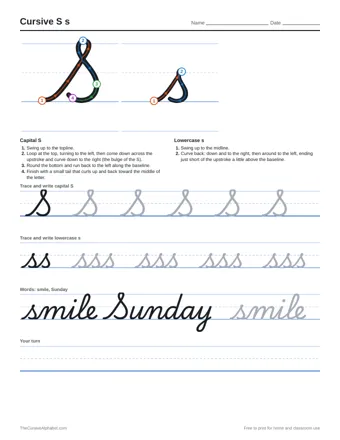
The sheet has the numbered stroke guide for both letters, rows to trace, two practice words and a blank row for writing on your own.