How to write cursive C and c
C is one of the easiest letters to learn: a single curve, big for the capital and small for the lowercase, with a short tail at the end. Many charts also show a second capital C that starts with a small loop.
Capital C
Tall: baseline to topline.
Just below the topline, on the right.
On the right, about halfway to the midline, swinging up into the next letter.
Lowercase c
Short: baseline to midline.
Just below the midline, on the right.
Low on the right, swinging up.
Capital C, second form
A C that starts with a small loop at the top. Some handwriting styles teach it this way; after the loop it is written like the first C.
Just below the topline, on the right, inside the small loop.
On the right, about halfway to the midline, swinging up into the next letter.
The curve is wider than you think. Keep the opening on the right, start just below the top, and let the tail lead out at the baseline.
Common mistakes with capital C
- A big loop is added at the start, so the C reads as a cursive O that was not closed.
- The tail is flat and long, so it reads as a crossbar.
- The C is drawn upright, without the slant of the other letters.
Common mistakes with lowercase c
- The curve closes on itself, so the c becomes an o or an a.
- The c is started low and drawn as a hook, so it reads as part of the next letter.
- The c is drawn the full height of the tall letters.
Joining c to other letters
Practice these pairs until the join feels like one movement.
Print a practice sheet for C and c
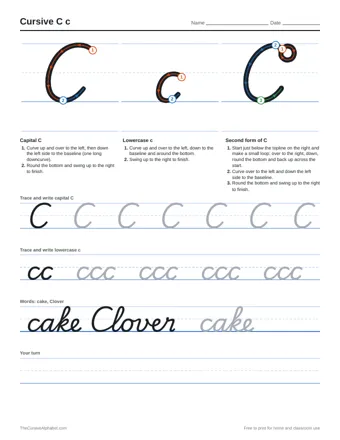
The sheet has the numbered stroke guide for both letters, rows to trace, two practice words and a blank row for writing on your own.