How to write cursive B and b
Capital B is a stem with two bowls stacked on the right. The pen lifts at the end, so the next letter starts on its own. Lowercase b is a tall loop and a stem, finished with a swing up to the midline.
Capital B
Tall: baseline to topline.
A little above the midline, on the left.
On the baseline, just right of the stem. The pen lifts; the next letter starts on its own.
Lowercase b
Tall: baseline to topline.
At the baseline, on the left.
At the midline, at the top of the upswing. When a letter follows, a short bridge runs right from here.
Make the lower bowl of the capital a little larger than the upper one, and tuck it in close to the stem. In the lowercase b, the swing up at the end is what joins it to the next letter, so stop it at the midline, not the baseline.
Common mistakes with capital B
- The two bowls are drawn as one big curve with no knot at the midline, so the B reads as a D.
- The retrace leaves the stem and draws a second line beside it.
- The lead-in is drawn as a loop at the top, so the B looks like it has a hat.
Common mistakes with lowercase b
- The bridge is left out, so the b reads as an l.
- The bridge sags down to the baseline, so the next letter starts in the wrong place.
- The loop is drawn wide, which makes the letter slow to write and hard to join.
Joining b to other letters
Capital B lifts before the next letter, so start the second letter fresh. Practice the lowercase pairs until each join feels like one movement.
Print a practice sheet for B and b
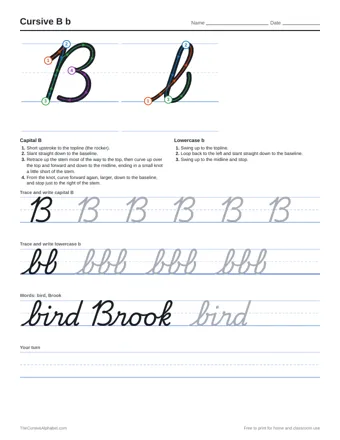
The sheet has the numbered stroke guide for both letters, rows to trace, two practice words and a blank row for writing on your own.