How to write cursive Q and q
Capital Q is a big oval with a small loop at the lower left and a tail that rises to the right. A second capital Q, written like a cursive 2, is common on US charts. Lowercase q is an a with a tail that loops to the right, the opposite way from a g.
Capital Q
Tall: baseline to topline.
On the left side of the oval, less than halfway up.
Low on the right, rising. The tail runs into the next letter.
Lowercase q
Short, with a tail below the baseline.
At the midline, on the right side of the oval.
Low on the right, swinging up.
Capital Q, second form
The Q that looks like a 2: up to the topline, a curve down to the left like a 2, a small loop at the baseline and a tail to the right. This is the Q most American school charts teach.
Just below the topline, on the left, inside a small curl.
Low on the right, rising. The tail runs into the next letter.
The lowercase g and q are twins until the loop under the line. The g loops left, the q loops right. That one turn is the whole difference.
Common mistakes with capital Q
- The bottom loop is drawn too high, inside the oval, so the letter looks like an O with a tail inside it.
- The tail is dropped straight down like a print Q, so there is nothing for the next letter to join.
- In the 2-shaped form, the top loop is left out and the letter becomes the numeral 2.
Common mistakes with lowercase q
- The tail is looped to the left, so the q reads as a g.
- The oval is not closed, so the q reads as a c with a j tail.
- The tail does not come back up through the baseline, so the q cannot join the u.
Joining q to other letters
Practice these pairs until the join feels like one movement.
Print a practice sheet for Q and q
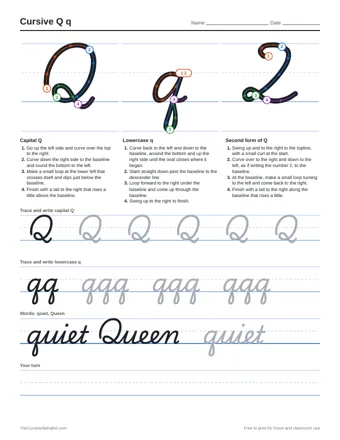
The sheet has the numbered stroke guide for both letters, rows to trace, two practice words and a blank row for writing on your own.