How to write cursive K and k
Capital K is a slanted stem with a second stroke that curves in to touch the stem at the middle, then turns back out as the leg. Lowercase k is a tall loop and a stem with a small closed loop pressed against it, just below the midline.
Capital K
Tall: baseline to topline.
Just below the topline, on the left, with a small curl.
Low on the right, swinging up: the tail reaches a third to half of the way to the midline and runs into the next letter.
Lowercase k
Tall: baseline to topline.
At the baseline, on the left.
Low on the right, swinging up.
The small loop in the lowercase k has to close against the stem. If it floats away from the stem, the letter reads as an h. Keep it small.
Common mistakes with capital K
- The arm never touches the stem, so the K falls into two pieces.
- The second stroke starts low, near the midline, so the arm is short and the letter looks like an R.
- The leg is drawn as a straight print stroke without the undercurve, so it cannot join.
Common mistakes with lowercase k
- The small loop does not close on the stem, so the k reads as an h.
- The leg starts high, from the loop, so the k looks like an R.
- The tall loop is drawn wide, so the letter spreads into its neighbours.
Joining k to other letters
Practice these pairs until the join feels like one movement.
Print a practice sheet for K and k
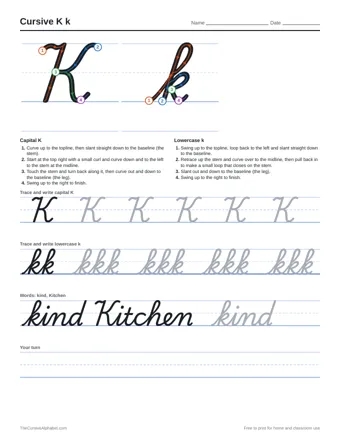
The sheet has the numbered stroke guide for both letters, rows to trace, two practice words and a blank row for writing on your own.