How to write cursive J and j
Both forms of J loop below the line. The capital goes over the top first; the lowercase starts at the midline like an i. Each one drops below the baseline, loops to the left, and comes back up to join the next letter.
Capital J
Tall, with a tail below the baseline.
About a third of the way up to the midline, on the left.
Low on the right, swinging up: the tail reaches a third to half of the way to the midline and runs into the next letter.
Lowercase j
Short, with a tail below the baseline.
At the midline. At the start of a word, many people add a short upstroke from the baseline first.
Low on the right, swinging up. The dot is added last.
Like the i, the lowercase j takes its dot last. The loop under the line turns to the left and should be about the same size as the loop on a g or y.
Common mistakes with capital J
- The bottom loop is drawn as big as the top loop, so the J looks like a figure 8 on a slant.
- The tail does not come back up through the baseline, so the letter ends under the line and cannot join.
- The stem stays above the baseline, so the J reads as an I.
Common mistakes with lowercase j
- The tail stays above the baseline, so the j reads as an i.
- The dot is forgotten.
- The lower loop crosses above the baseline or is drawn big.
Joining j to other letters
Practice these pairs until the join feels like one movement.
Print a practice sheet for J and j
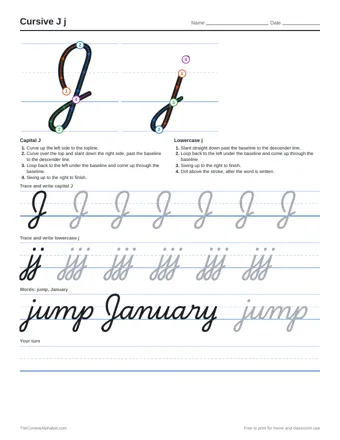
The sheet has the numbered stroke guide for both letters, rows to trace, two practice words and a blank row for writing on your own.